Total pages in book: 106
Estimated words: 96271 (not accurate)
Estimated Reading Time in minutes: 481(@200wpm)___ 385(@250wpm)___ 321(@300wpm)
Estimated words: 96271 (not accurate)
Estimated Reading Time in minutes: 481(@200wpm)___ 385(@250wpm)___ 321(@300wpm)
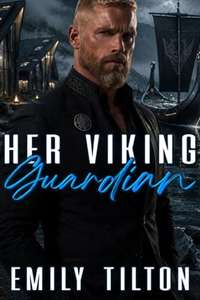
When I stumbled upon an ancient Norse ceremonial site, I didn’t expect to end up not only the captive of a ruthlessly sexy billionaire, but bare, bound, and helplessly available for his use.
But as Henrik Magnusson tears off my clothes and bends me over with my spanked a$$ still sore, I know he’s not just going to ravage me while I buck and writhe and c*me so hard I see visions.
Because he’s not just a powerful man teaching a naughty girl a shameful lesson.
He’s a Son of Odin.
And he’s going to claim me the way a Viking claims his bride.
Publisher’s Note: Her Viking Guardian is the third book in the Bound for Training series but can be read as a standalone. It includes spankings, sexual scenes, intense and humiliating punishments, and strong D/s themes. If such material offends you, please don’t read this book
*************FULL BOOK START HERE*************
CHAPTER 1
Ilsa
No real archaeologist, let alone a lowly grad student like me, ever actually got to uncover a mosaic that reshapes everything she thought she knew about the past.
That, however, was exactly what had just happened to me. Maybe it didn’t change everything I had thought I knew about the past, but it changed the parts that mattered most to me. The parts about the Normans in Sicily in the eleventh and twelfth centuries.
The tesserae beneath my brush told a story that no textbook had ever whispered, let alone proclaimed. I had been working the site, outside Palermo, for three weeks already, cataloging every detail of what the rest of the dig team had dismissed as a servants’ house. I felt certain, based on the dimensions, that it was actually the undercroft of a Norman chapel.
I had almost given up hope when the pattern had begun to emerge. Not the interlocking geometric borders that characterized standard Sicilian-Norman work of the period, not the medallions that any first-year art history student could identify as Byzantine. Something older. Something that had no business being here at all.
I sat back on my heels and pressed my wrist against my forehead, careful not to touch my face with the brush hand. The late afternoon light slanted through the narrow window slits of the undercroft, catching the gold leaf tesserae at an angle that made them burn like small fires set into the earth. My heart was doing something undignified and unscholarly in my chest.
The central design seemed unmistakable.
Not Christ. Not the Virgin. Not any of the saints whose iconography I had spent a big part of my doctoral coursework memorizing.
A tree. Specifically, a tree whose roots descended into three distinct realms rendered in lapis and obsidian glass, whose branches would clearly spread across the top of the composition in a pattern I had seen before, not in any Sicilian context, but in illuminated manuscripts from a monastery outside Bergen that I had studied during my undergraduate thesis year.
Yggdrasil.
Here. Beneath a Norman chapel. In Sicily.
I set my brush down with extreme care, because my hands had started to shake.
The academic part of my brain, the stubborn intellectual part that had gotten me through my qualifying exams and three rejection letters from major journals before my first acceptance, had already begun to construct the argument. The Normans had come south into France, yes, but they were Norse in origin. Eleventh century. The conversion had been relatively recent. It was not, strictly speaking, impossible that some remnant of the old belief system had traveled with them, had found expression in a private space, an undercroft, a place below the official architecture of the new faith.
Not impossible. Extraordinary, certainly. Career-defining, possibly.
The other part of my brain, the part I didn’t discuss in academic papers or with my dissertation committee, was doing something else entirely. It was looking at the female figure I had only just begun to uncover at the base of the tree, her form emerging from centuries of grime and careful brushwork, and feeling a recognition that had nothing whatsoever to do with scholarship.
She was tall. Angular-featured. Her hair, rendered in silvered tesserae, fell in loose waves.
My grandmother’s pendant, the small rune-carved disc I wore always at my throat, suddenly felt warm against my skin.
I told myself it was the Sicilian heat. The day’s weather, plus confirmation bias.
Then I saw the border inscription, and confirmation bias became the least of my problems, because I couldn’t have imagined those letters if I’d tried.
The text ran along the lower edge of the composition in a band I had taken, in my initial excitement over the tree, for decorative knotwork. It wasn’t knotwork. It was language, the Latin the cosmopolitan Norman court had used alongside old French and Greek and Arabic. The words, however, weren’t written in the Roman capitals familiar to any literate Norman cleric.
The script was Younger Futhark, the Norse runes I knew only because, well, I had been a Norse myth geek in high school. They read, Filii Mercurii. Hic Incipit Via.
Latin, written in Norse runes. Not unheard of, as the church began its inexorable march through the Scandinavian lands. Unheard of here, though, in Sicily, where the Normans had long since adopted Roman writing despite their Norse heritage.
Sons of Mercury. Here the road begins.
My Latin was adequate. My Latin was, my committee would have said with the faint approval they rationed carefully, more than adequate.
And I had used it to read Tacitus. Or anyway the one book of Tacitus that mattered to me, the Germania, with its precious witness to the tribes that would migrate to Scandinavia and become the Vikings.
Including the passage in which the Roman historian had described the Germanic tribes worshipping a god he called Mercury, a god like the Romanized version of Hermes. A god of travelers and cunning and the dead… a god who was obviously not Mercury or Hermes at all, but something from a different kind of supernatural world. A colder and far less civilized one.