Total pages in book: 116
Estimated words: 109878 (not accurate)
Estimated Reading Time in minutes: 549(@200wpm)___ 440(@250wpm)___ 366(@300wpm)
Estimated words: 109878 (not accurate)
Estimated Reading Time in minutes: 549(@200wpm)___ 440(@250wpm)___ 366(@300wpm)
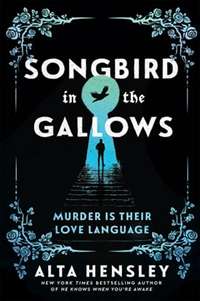
Murder is their love language…
Five years ago, Saylor Mitchell’s father was brutally murdered in front of her, shattering her world. Now his killers have tracked her down to finish the job. She is unexpectedly saved by her father’s closest friend, the enigmatic Blue. Saylor's savior—and captor— is a reformed, murder-sober assassin struggling to escape the clutches of his own violent history.
Blue’s gothic mansion, perched on the edge of a cliff overlooking a stormy sea in the town of Grimlock, is a labyrinth of secrets. And so is Grimlock, a small town whose residents all seem to have a penchant for murder that they’ve managed—mostly— to overcome.
Saylor soon realizes that Blue holds the key to avenging her father’s murder at the hands of the Crow, a gang of amoral contract killers. Only problem? Saylor has never killed before. Good thing those who can’t kill…teach.
Blue finds Saylor an apt pupil and the attraction between them morphs into a dangerous obsession. Can their love conquer Blue’s final, darkest secret?
Morally grey leadsTouch her and dieDad’s best friendPossessivenessGothic mansionMurder mysteryForbidden loveAge gapForced proximityAnti-heroDark romanceGothic romanceFairytale retelling
*************FULL BOOK START HERE*************
Chapter One
Saylor
Once upon a time, I believed in right and wrong.
Before I learned the truth. Learned it in the spray of my father’s blood, felt it hot across my face while I choked on the urge to scream. The sound of him dying is still inside me, a metronome to every choice I make.
There’s a bone-deep truth. A blood-written truth . . .
It’s not what you do, but why you do it.
The driving force that lives beneath your skin, pulsing with every heartbeat, whispering justifications in the dark hours when sleep won’t come. When you understand someone’s why—when you relate to it, fall in love with it, cradle it against your chest like a secret—that’s what can turn the villain in any story into the hero.
But maybe this is the real question: Who is the villain?
Can you be the villain in your own story? Can you watch yourself make choices that would horrify the person you used to be, and still believe you’re doing the right thing?
Can you go from rabbit to wolf and convince yourself it was always your true nature, that the innocence was just a costume you wore until the world forced you to shed it?
I think about this now, when my hands are steady and my conscience is quiet. When the weight of what I’ve done settles into my core, and I can look in the mirror without flinching at what stares back. When love means something different than it did before. It’s deeper, more honest, written in a language that most people are too afraid to learn.
* * *
They say you can disappear in New York. Become someone new between one subway stop and the next. I should know—I’ve been Saylor Mitchell for so long now that sometimes I forget I was ever Sara Mitchell.
But here’s the thing about running: You can change your name, dye your hair raven black, build a whole new life, but some things follow you. The phantom weight of your father’s blood on your hands. The sound a throat makes when it’s being cut. The way your real name sits like a stone in your chest, even when no one’s called you that in years.
These nights performing at the White Note are the only time I feel like both versions of myself can coexist. Where scattered applause and clinking glasses create their own kind of percussion, and cigarette smoke curls through the air like visible notes. Where Saylor Mitchell sings jazz for tips, but Sara Mitchell’s rage hums underneath every note.
I’d considered changing my last name too—new identity, clean slate. But Mitchell was my father’s name, and as much as I needed to disappear, I couldn’t bring myself to lose that last piece of him. So Sara became Saylor, but Mitchell stayed. A small rebellion against my own survival instincts.
The cabaret is dimly lit, smoky, a place where secrets thrive in dark corners. I scan the crowd as I slink across the stage, my scarlet-red sequined dress catching the light. My fingers find the compass necklace at my throat—Dad’s compass. Antique brass on a simple chain, the face no bigger than a quarter. It clashes with everything I wear, too practical for sequins and satin, but I haven’t taken it off since that awful night. North still points north, even when everything else in my life points nowhere. I give it a quick touch for luck. Same ritual every night since I started singing here.
As the sultry melody from the band fills the room, I adjust the rose in my slicked-back black hair and take hold of the microphone. It’s time for me to seduce the crowd and lose myself in the music.
I close my eyes and let my body move to the rhythm, swaying my hips and running my hands down my curves. The audience is captivated, their eyes following every movement of my body.
My voice comes out low and smooth as I sing the first line of “Fever,” a classic jazz song that never fails to get hearts racing. It’s not my favorite song—too mainstream for my tastes—but Joey, the club owner, insists I start each set with it. Says it draws in the regulars.
Sometimes I wonder if the regulars would recognize Sara in Saylor. But Sara was an eighteen-year-old girl from Seattle who watched her father die, who ran to New York with nothing but the clothes on her back and a fake ID she bought at Port Authority. Saylor is twenty-three, trying to be confident, and attempting to never look over her shoulder. Sara hid in closets. Saylor owns every stage she steps on. Not that anyone here knows there’s a difference.
The music shifts into something slower, sultrier. My hips follow the rhythm as I work through the standards. Songs that pay rent and keep me invisible. Each performance is a balancing act between being memorable enough for tips but forgettable enough that no one asks too many questions about where I came from.